
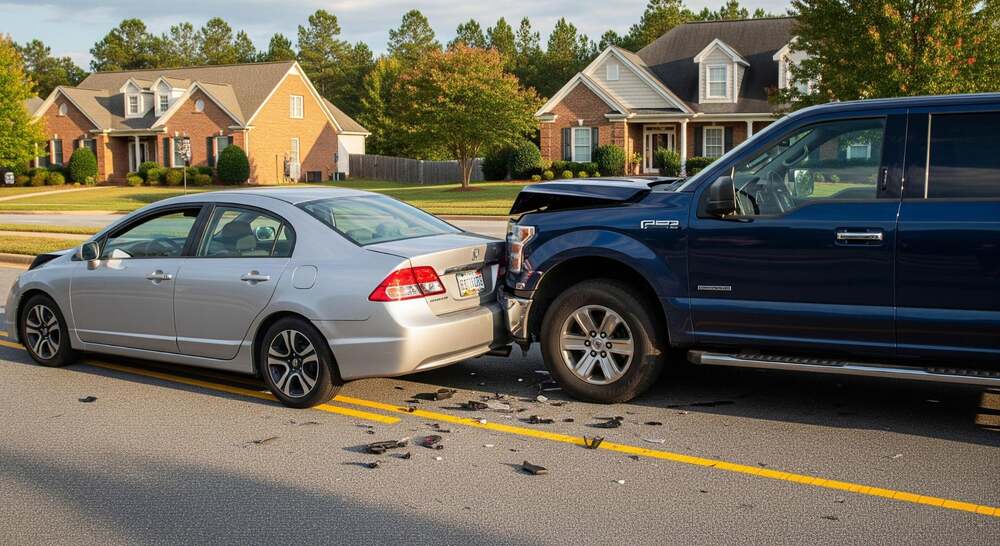
If you were in a car accident in North Carolina, you may be able to recover compensation for more than just your immediate repair bill. Depending on the facts, your claim may involve medical bills, lost income, pain and suffering, property damage, and, in rare situations, additional damages such as punitive damages or wrongful death damages when a crash is fatal. How much you actually recover depends on what you can prove, how North Carolina’s contributory negligence rule applies, and what insurance or assets are available.
Lanier Law Group represents crash victims across North Carolina, including Raleigh, Charlotte, Wilmington, Greenville, and surrounding counties. Understanding how state law treats different categories of damagesh can help you see what may be available in your situation and why documentation matters.
Most North Carolina Car Accident Claims Involve Economic and Non-Economic Damages
Most North Carolina car accident claims seek compensation in a few familiar categories. The first is financial loss, such as medical bills, lost wages, and other out of pocket costs. The second is non financial harm, such as pain, emotional distress, and changes to day to day life. The third is property damage to your vehicle and personal belongings. In limited situations, North Carolina law also allows punitive damages or wrongful death damages.
How much you can actually recover in each category depends on the facts of the crash, the strength of your evidence, any arguments about shared fault, and the amount of insurance coverage or assets that can be reached. North Carolina’s contributory negligence rule and policy limits both play a significant role in the final outcome.
At a high level, the main groups are:
- Economic damages
- Non economic damages
- Property damage
- Punitive damages (rare)
- Wrongful death damages (for fatal crashes)
What Types of Damages Are Available After a Car Accident in North Carolina?
In North Carolina car accident cases, damages are usually grouped into economic damages, non economic damages, property damage, and, in certain cases, punitive or wrongful death damages. These categories reflect how courts and insurers in this state evaluate compensation.
Broadly:
- Economic damages are your financial losses, such as medical bills, lost wages, and future medical costs.
- Non economic damages are the human impacts such as pain, emotional distress, and loss of enjoyment of life.
- Property damage covers vehicle repair or replacement and related property costs.
- Punitive damages are additional damages designed to punish extreme conduct, available only in very limited circumstances.
- Wrongful death damages apply when a crash is fatal and the claim is brought on behalf of someone who died.
These categories apply whether your crash happened on a major interstate or a local street anywhere in North Carolina.
Do These Types of Damages Apply in Raleigh, Charlotte, and Wilmington?
Yes. The same categories of damages apply statewide under North Carolina law. Whether your crash happened in Raleigh, Charlotte, Wilmington, Greenville, or any other city or county, the types of damages you can seek are governed by state statutes and case law, not local rules.
What can change from place to place is how insurers and juries value a particular case. Some venues are viewed as more conservative or more generous, and that can affect settlement negotiations. The menu of potential damages, however, is the same across the state.
Economic Damages: Medical Expenses, Lost Income, and Out-of-Pocket Costs
Economic damages are the measurable financial losses caused by the crash. They include past and future medical expenses, lost wages, loss of earning capacity, and out of pocket costs such as medications, mileage, and other expenses you would not have had without the accident.
Juries in North Carolina are instructed to consider medical expenses and loss of earnings as part of the damages when those losses are reasonable, necessary, and caused by the crash. Insurance adjusters evaluate the same categories when deciding what to offer.
Common economic damage categories include:
- Medical expenses, past and future
- Lost wages from time missed at work
- Loss of earning capacity when injuries affect future income
- Out of pocket costs such as transport, medications, equipment, childcare, and home help
- Property related expenses such as rental car, towing, and storage
What Medical Bills Can Be Included in a North Carolina Car Accident Claim?
Most medically necessary treatment connected to crash related injuries can be included in a North Carolina car accident claim. That typically covers:
- Emergency room visits at local hospitals
- Hospitalization and observation stays
- Imaging such as X rays, CT scans, and MRIs
- Surgeries and outpatient procedures
- Specialist visits, such as orthopedists, neurologists, or pain management doctors
- Physical therapy, occupational therapy, and sometimes chiropractic care
- Prescription medications and necessary over the counter medications
- Medical devices such as braces, boots, crutches, or TENS units
- Mileage or transportation costs to and from treatment in appropriate cases
To claim these amounts, you usually need both records, to show what was done and why, and bills, to show what was charged. Insurers and juries look closely at whether treatment was reasonable and necessary in light of the injuries and how closely it follows the accident in time.
Can I Recover Lost Wages and Reduced Earning Capacity in North Carolina?
You can generally recover past lost wages if you missed work or your hours were reduced because of crash injuries. That can include regular pay, overtime, and, in some cases, missed bonuses or commissions. Proof often comes from:
- Employer wage verification letters
- Pay stubs and W 2s
- Tax returns in some cases
- Timesheets or scheduling records showing missed days and reduced shifts
Reduced earning capacity is different. It refers to future income you lose because your injuries affect the kind of work you can do or the number of hours you can work. For example, a shoulder injury that prevents a return to heavy labor, or a head injury that limits certain tasks, can reduce earning capacity even if you remain employed.
Proving loss of earning capacity usually requires more detailed medical evidence about permanent restrictions and, in larger cases, vocational or economic expert input to quantify the impact over time.
Can I Be Compensated for Future Medical Care and Other Ongoing Costs in North Carolina?
If your doctors expect that you will need ongoing treatment, medications, or additional procedures because of crash related injuries, those anticipated costs can be part of your economic damages. That might include:
- Future surgeries or injections
- Continued physical therapy or rehabilitation
- Long term pain management care
- Periodic follow up appointments with specialists
- Ongoing medications or durable medical equipment
Insurers examine future damages closely. You generally need clear statements from providers about what future care is likely, how often, and why it is tied to the crash. In some cases, a life care planner or similar specialist may prepare a projection of future care and cost. Thorough documentation of future medical needs can significantly affect the overall value of a claim.
Non-Economic Damages: Pain and Suffering and Life Impact
Non economic damages compensate for the human consequences of an accident that do not appear on invoices. They often include:
- Physical pain and discomfort
- Emotional distress, anxiety, and depression
- Loss of enjoyment of life and hobbies
- Scarring and disfigurement
- Permanent impairment and disability
In ordinary North Carolina car accident cases, there is no general cap on non economic damages. Juries are instructed to consider evidence about how the injuries have affected your life and to award an amount they believe is fair. Medical malpractice claims are handled under a separate framework that includes its own non economic cap.
Examples of non economic impacts include:
- Daily pain that makes routine tasks harder
- Fear or anxiety when driving or riding in a vehicle
- Inability to participate in hobbies, sports, or family activities
- Trouble sleeping, irritability, or changes in mood
- Embarrassment or self consciousness from scarring or visible injuries
How Is Pain and Suffering Evaluated in a North Carolina Car Accident Case?
There is no official multiplier or formula in North Carolina law for pain and suffering. Insurers and juries look at factors such as:
- How severe your injuries are
- How long symptoms last and whether they are permanent
- How daily life has changed at work, at home, and in relationships
- How much treatment is required and whether more treatment is expected
Medical records that include pain complaints, physical examination findings, and notes on activity limits are important. Personal journals and testimony from you and people close to you can also help show how the crash changed your life over time, rather than at a single point.
Can I Recover for Emotional Distress After a North Carolina Car Accident?
Emotional distress can be part of non economic damages when it is caused by the crash and supported by credible evidence. Common post crash emotional impacts include:
- Anxiety, particularly related to driving or travel
- Nightmares or other sleep disturbances
- Panic attacks or fear of certain roads or intersections
- Depression or loss of interest in activities
Treatment notes from mental health providers, primary care records that document anxiety or mood issues, and consistent descriptions from you and people close to you help substantiate this part of a claim. Emotional harm often develops and changes over time, so ongoing documentation can be important.
Property Damage: Repairs, Total Loss, Rental Car, and Diminished Value
Property damage is a separate part of a North Carolina car accident claim. It may include:
- Repair costs if your vehicle is fixable
- Total loss value if your vehicle is beyond reasonable repair
- Related costs such as towing, storage, and rental cars
- Damage to personal property inside the vehicle, such as phones or child seats
Diminished value is an additional property related harm. Even after quality repairs, a vehicle can be worth less on the open market because it now has a crash history.
What Happens If My Car Is Totaled in a North Carolina Crash?
If your car is considered a total loss, it usually means the estimated cost to repair it is so high compared to its value that the insurer classifies it as totaled. In most cases, the at fault driver’s liability insurer, or your own collision coverage if you use it, pays the vehicle’s fair market value immediately before the crash.
Fair market value is generally based on what a similar vehicle would sell for in your area, considering age, mileage, condition, and options. If you want to keep the vehicle, you may be able to do so, but the settlement is often reduced by the salvage value. Clear documentation of your vehicle’s condition and equipment is important when negotiating a total loss value.
Can I Make a Diminished Value Claim in North Carolina After Repairs?
Yes. Diminished value is the reduction in your vehicle’s market value after a crash even if it is properly repaired. A repaired vehicle often sells for less than a comparable vehicle with a clean history.
To pursue a diminished value claim, you generally need evidence of:
- The vehicle’s value before the crash
- The vehicle’s value after repairs, accounting for the accident history
This may involve market comparisons, dealer opinions, or a professional appraisal. Diminished value claims are more common in newer or higher value vehicles where the difference in resale value can be significant.
Can I Recover Rental Car, Towing, and Other Property-Related Expenses in North Carolina?
In addition to fixing or replacing your vehicle, many people can seek reimbursement for certain property related expenses, including:
- Rental car costs for a reasonable period while your vehicle is being repaired or a total loss is being processed
- Towing fees from the scene of the crash to a repair shop or storage lot
- Storage charges for your vehicle at a tow yard or facility
- Replacement of damaged personal items in the vehicle, such as child seats, glasses, or electronics
Receipts and invoices from towing companies, storage facilities, rental agencies, and repair shops are important to support these claims. Insurers often review whether the rental period and charges are reasonable, so keeping clear records can help avoid disputes.
When Punitive Damages May Be Available in a North Carolina Car Accident
Punitive damages are not intended to compensate you for losses. They are meant to punish and deter particularly dangerous conduct. In car accident cases, punitive damages are only potentially available when the at fault driver’s behavior goes beyond ordinary negligence and falls into categories such as fraud, malice, or willful or wanton conduct.
Examples might include extremely intoxicated driving with a very high blood alcohol level, drag racing through a crowded area, or deliberate road rage. Punitive damages are uncommon and require a specific legal showing in addition to proof of the underlying injury claim.
What Is the Legal Standard for Punitive Damages in North Carolina?
To obtain punitive damages in North Carolina, you must first prove that the defendant is liable for compensatory damages. Then you must show, by clear and convincing evidence, that the defendant’s conduct involved:
- Fraud
- Malice
- Willful or wanton conduct
Willful or wanton conduct generally means behavior that shows a conscious and reckless disregard for the rights and safety of others. Simple inattentive driving, by itself, is not enough. Whether the facts support punitive damages is a case specific question that depends on the details of the driver’s conduct and prior history.
Is There a Cap on Punitive Damages in North Carolina?
North Carolina caps punitive damages. In most cases, the cap is three times the amount of compensatory damages or $250,000, whichever is greater, subject to narrow statutory exceptions. If a jury awards a higher amount, the court may reduce punitive damages to stay within the cap.
Punitive damages rarely drive the overall value of a car accident case. Most claims are built around compensatory damages, including medical expenses, lost income, pain and suffering, property damage, and, in fatal cases, wrongful death damages.
What Can Limit Recovery in North Carolina: Contributory Negligence and Coverage Limits
Two major forces can limit car accident damages in North Carolina even when injuries are serious: the contributory negligence rule and insurance coverage limits.
North Carolina follows a pure contributory negligence rule. If the defense proves that you were even slightly at fault and that your negligence contributed to the crash, you may be barred from recovering compensation from the other driver. In many other states, partial fault reduces recovery. In this state, proven contributory negligence can block it.
Coverage limits are the practical ceiling on what most people can collect. If the at fault driver has a minimum limits policy and few assets, even a large verdict may not be fully collectible without additional coverage, such as your own uninsured or underinsured motorist coverage or an umbrella policy.
Can I Recover Damages If the Insurance Company Says I Share Fault in North Carolina?
An adjuster stating “we think you are partly at fault” is not the same as a court finding that you were contributorily negligent. However, the stakes are high in North Carolina because proven contributory negligence can bar recovery altogether.
Insurers know this and may use allegations of partial fault to justify low offers or denials. If you are told that you share fault, the key question is whether the evidence will support that position. Crash reports, physical evidence from the scene, photographs, video, and witness accounts all matter.
Because the consequences of contributory negligence are so serious, it is wise to talk to a lawyer before accepting an insurer’s shared fault assessment or agreeing to a settlement that assumes you were partly responsible.
What If the At-Fault Driver Does Not Have Enough Insurance to Cover My Damages?
If your damages are higher than the at fault driver’s liability policy limits, you may not be able to collect full value from that insurer alone. For example, if your medical bills, wage loss, and other damages total $300,000, but the at fault driver only has a $50,000 policy, the liability coverage will not cover the full loss.
Other potential sources may include:
- Your own underinsured motorist (UIM) coverage
- Uninsured motorist (UM) coverage if the at fault driver had no insurance
- MedPay coverage on your auto policy for certain medical expenses
- Umbrella or excess policies, if they exist
Identifying all applicable coverage and understanding policy limits is an important part of determining what you can realistically recover in a North Carolina car accident case.
Wrongful Death Damages When a North Carolina Car Accident Is Fatal
When a crash is fatal, the legal focus shifts from an individual personal injury claim to a wrongful death action. In North Carolina, wrongful death claims are governed by statute and are brought on behalf of the decedent’s estate. The categories of recoverable damages are defined by G.S. 28A 18 2 and include both economic and non economic components.
The wrongful death claim is brought by the personal representative, either an executor named in a will or an administrator appointed by the court if there is no will. Damages are then distributed to statutory beneficiaries according to the wrongful death statute.
What Damages Are Recoverable in a North Carolina Wrongful Death Car Accident Case?
North Carolina’s wrongful death statute lists several categories of damages that may be recoverable after a fatal car accident, including:
- Medical expenses incurred as a result of the injury leading to death
- The decedent’s pain and suffering between the time of injury and death
- Reasonable funeral and burial expenses
- The present monetary value of the decedent to statutory beneficiaries, including expected earnings, services, care, companionship, and guidance
- Punitive damages, in appropriate cases, if the decedent could have recovered them had they survived
The precise mix of damages depends on the facts of the crash, the decedent’s age and life circumstances, and the evidence available to show both economic and non economic impact.
Who Brings the Wrongful Death Claim After a Fatal Car Accident in North Carolina?
In North Carolina, the wrongful death claim is brought by the personal representative of the decedent’s estate, not by individual family members filing separate lawsuits. The personal representative:
- Collects information and documentation about the crash, injuries, and losses
- Works with counsel to pursue the claim and, if necessary, file suit
- Distributes any recovery to beneficiaries as the wrongful death statute requires
Because wrongful death cases involve both injury law and estate administration, they can be complex. Legal guidance can help ensure that all potential categories of damages are considered and that procedural requirements are met.
Practical Next Steps to Document Damages and Protect Your North Carolina Car Accident Claim
What you do in the days and weeks after a crash can significantly affect how well you prove your damages and how insurers view your claim. Good documentation and careful communication can strengthen a case. Missed steps can erode value.
Helpful next steps include:
- Obtaining your crash report number and, when it becomes available, ordering a copy of the North Carolina crash report
- Following up with medical providers, attending recommended appointments, and keeping written copies of restrictions and treatment plans
- Saving and organizing medical bills, records, receipts, and explanation of benefits notices
- Tracking missed work and documenting wage losses with letters from your employer and pay stubs
- Photographing your injuries, vehicle damage, and, if possible, the scene or hazards involved
- Keeping receipts for property related expenses such as towing, rental car, and storage
- Avoiding recorded statements or detailed discussions about fault with the other driver’s insurer until you understand your rights
- Considering an early consultation with a North Carolina car accident lawyer to review damages, coverage options, and legal deadlines
What Documents Should I Save to Prove Damages After a North Carolina Car Accident?
To prove your damages, it helps to save everything that shows what the crash has cost you. That includes:
- The crash report and any incident reports
- Medical records from every provider who treated you for crash related injuries
- Itemized medical bills and insurance explanation of benefits statements
- Employer letters confirming missed time from work and any changes in duties or hours
- Pay stubs and, if needed, tax returns showing earnings before and after the crash
- Photos and videos of vehicles, the scene, visible injuries, and hazards
- Repair estimates and invoices, appraisals, and diminished value reports for your vehicle
- Towing, storage, rental car, and other property related receipts
- Receipts for out of pocket costs such as medications, equipment, parking, and tolls for appointments
- Copies of correspondence with insurers, including emails and letters
Keeping this documentation organized makes it much easier to present a clear, supported claim and to respond to questions from adjusters and experts.
What Should I Do This Week After a Car Crash in North Carolina?
In the first week after a crash in North Carolina, a few practical steps can go a long way toward protecting your claim’s value:
- See a doctor or follow up with your existing provider to document injuries and obtain a treatment plan
- Start a simple journal describing pain, symptoms, and how they affect your activities
- Request or note your crash report number from law enforcement so you can obtain the report when it is ready
- Notify your own auto insurer and confirm your claim number and coverages
- Ask your employer to document any missed work and changes in duties or hours
- Collect and save photos, videos, and contact information for witnesses
- Avoid posting about the crash or your injuries on social media
- Decline recorded statements with the other driver’s insurer until you understand the legal implications
- Consider contacting Lanier Law Group to review your damages, coverage options, contributory negligence risk, and deadlines
No one can state the exact value of a case in a single sentence, but understanding the types of damages that may be available, how contributory negligence and coverage limits affect recovery, and how to document your losses gives you a clearer starting point. Before accepting any offer, it is prudent to seek a case specific evaluation so you know what you may be giving up.
Get Help Understanding Your North Carolina Car Accident Damages
If you are trying to understand what your North Carolina car accident claim may include, you do not have to sort through damage categories and insurance rules by yourself. Between medical bills, lost income, property damage, pain and emotional distress, and, in tragic cases, wrongful death damages, it can be hard to know what is realistically available in your situation. North Carolina’s contributory negligence rule and policy limits add more complexity, because one argument about shared fault or a low coverage limit can dramatically change what you actually recover, even when your losses are significant.
If you have questions about which damages apply to your case, how contributory negligence and coverage limits affect your recovery, or what to do next, you do not have to make those decisions alone. Call Lanier Law Group at 919-342-1368 or contact us online for a free consultation. Our team is ready to review your crash, explain your options under North Carolina law, and fight like heavyweights to protect your right to pursue full compensation for all of your accident-related losses.