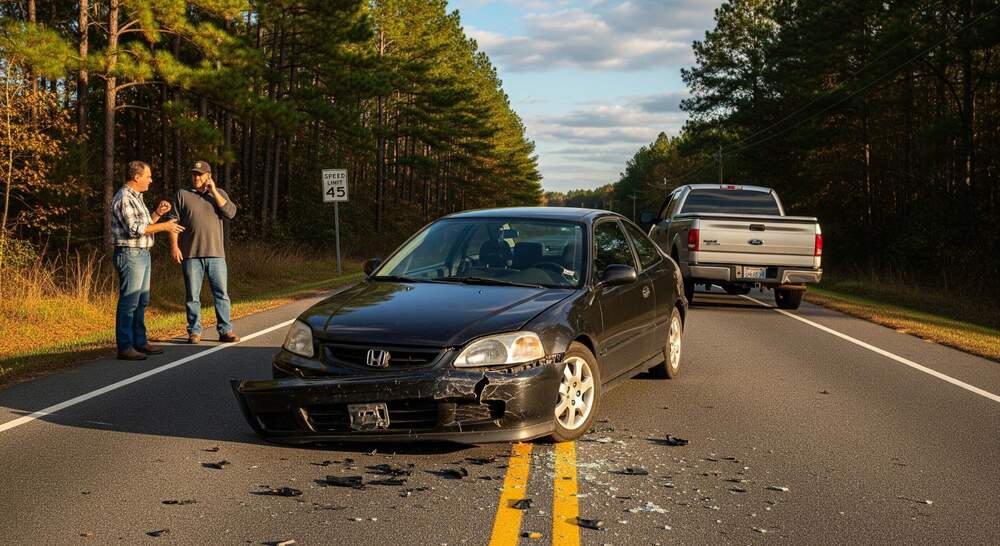
If you are hit by an uninsured driver in North Carolina, you usually do not have to absorb the loss on your own. Most North Carolina auto policies include uninsured motorist (UM) coverage that can pay for injuries and property damage when the at-fault driver has no insurance or leaves the scene. To use that coverage, you still need to prove fault, document your injuries and losses, and follow the claim rules and deadlines in your policy.
Understanding how UM coverage works can make a difficult situation more manageable. The sections below explain what happens when the at-fault driver is uninsured, how UM differs from underinsured motorist (UIM) coverage, what UM can pay for, the steps to take after a crash, how UM claims work with your own insurer, common pitfalls, when a lawsuit against the uninsured driver makes sense, and when to speak with a North Carolina car accident lawyer.
What Happens If the Other Driver Is Uninsured in North Carolina?
If the other driver is uninsured in North Carolina, you typically rely on uninsured motorist coverage under your own auto policy. In a UM claim, your insurer takes the legal role that the at-fault driver’s insurer would normally play. If you meet the policy conditions, UM can pay for your injuries and property damage up to your UM limits. You must still show that the other driver caused the crash, document your medical bills and other losses, and comply with notice and cooperation requirements.
The same general approach often applies in hit-and-run crashes that qualify as uninsured motorist events. Delayed reporting, weak documentation, or contributory negligence arguments can reduce or eliminate what you can recover, which is why prompt reporting and clear records are important.
Do I Have Options If the Other Driver Has No Insurance in North Carolina?
In many North Carolina accidents where the at-fault driver has no liability insurance, you still have options. UM coverage on your own policy can pay for your injuries and, when applicable, your vehicle damage, up to your UM limits.
This protection applies across the state, whether an uninsured driver hits you in Raleigh, Charlotte, Wilmington, or another community. The total amount you can recover remains limited by your UM limits, and you must still prove the other driver was negligent and that your injuries and losses came from the crash.
What If the Uninsured Driver Leaves the Scene in North Carolina?
When the other driver leaves the scene, North Carolina policies often treat the crash as a hit-and-run that can qualify as an uninsured motorist event. To preserve your ability to make a UM claim, policies commonly require you to:
- Call 911 or promptly report the crash to law enforcement
- Obtain a police report (DMV-349) documenting the hit-and-run
- Cooperate with your insurer’s investigation of the crash
At the scene, try to gather as much information as you safely can, such as a vehicle description, any portion of the license plate, the location of the collision, and witness contact information. These details help corroborate that the crash occurred and support the use of UM coverage.
Uninsured vs Underinsured in North Carolina: Why the Difference Matters
In North Carolina, uninsured and underinsured vehicles are treated differently for insurance purposes. Uninsured motorist coverage applies when the at-fault driver has no liability insurance, has lapsed coverage, or in many cases when the driver flees the scene and is not identified. Underinsured motorist (UIM) coverage applies when the at-fault driver has liability insurance, but the limits are too low to cover your full damages and your UIM limits are higher.
Both UM and UIM protections come from North Carolina’s Financial Responsibility Act, N.C. Gen. Stat. § 20-279.21. Policies issued or renewed in North Carolina must include UM coverage at least at the state minimum limits, and many policies also include UIM. Whether a crash is treated as uninsured or underinsured determines which coverage applies and how much may be available.
| Type | When It Applies | Example |
| Uninsured (UM) | At-fault driver has no liability coverage, or certain hit-and-run situations | You are rear-ended in Raleigh and the driver admits they have no insurance |
| Underinsured (UIM) | At-fault driver has liability coverage, but limits are lower than your damages and your UIM limits | You suffer serious injury in Charlotte and the at-fault driver carries minimum limits that do not cover all of your medical bills and lost wages |
| Hit-and-Run | Often treated as uninsured under policy terms | You are sideswiped on I-85 and the other driver flees before you can obtain their information |
What Is the Difference Between Uninsured and Underinsured Motorist Coverage in North Carolina?
Uninsured motorist coverage in North Carolina applies when the at-fault driver has no liability insurance or in many qualifying hit-and-run scenarios. It lets you seek compensation from your own insurer as if it were the at-fault driver’s insurer. Underinsured motorist coverage applies when the at-fault driver has some insurance but not enough to cover your damages. In that case, UIM can pay additional amounts up to your UIM limits once the at-fault driver’s liability limits are exhausted.
Both coverages are usually listed on your policy’s declarations page. Which one applies depends on whether the at-fault driver is uninsured, underinsured, or unknown.
Does a Hit-And-Run Count as Uninsured in North Carolina?
In many North Carolina policies, a hit-and-run is treated as an uninsured motorist event, which means you may be able to use your UM coverage if you meet the policy requirements. Those requirements often include:
- A prompt report to law enforcement, usually by calling 911 from the scene or soon after
- A timely claim notice to your insurer
- Corroborating evidence, such as physical damage consistent with a collision or an independent witness
Some policies require physical contact with the other vehicle and may not cover situations where there is no contact and no evidence beyond your own description. Because policy language differs, it is important to review your declarations page and policy or speak with a lawyer about whether a particular hit-and-run qualifies for UM coverage.
What Uninsured Motorist Coverage Can Pay For: Injuries and Property Damage
Uninsured motorist coverage in North Carolina is meant to provide compensation similar to what would have been available if the at-fault driver had liability insurance. UM bodily injury coverage can help pay for:
- Medical bills, including ER and hospital care, imaging, surgery, therapy, and related treatment
- Future medical expenses reasonably expected because of the crash
- Lost wages and, in appropriate cases, reduced earning capacity
- Pain and suffering, emotional distress, and reduced enjoyment of life
- Reasonable out-of-pocket costs tied to the injury
Uninsured motorist property damage (UMPD), if your policy includes it, can help pay for repair or total loss of your vehicle, subject to policy limits and any deductibles. If you have collision coverage, that may also cover car damage regardless of whether the other driver is insured, though collision has its own deductible. The specific mix of coverages that apply depends on the details in your policy.
Does Uninsured Motorist Coverage Pay Medical Bills and Lost Wages in North Carolina?
UM bodily injury coverage in North Carolina can pay for crash-related medical expenses and lost wages when an uninsured driver is at fault, up to your UM limits. It functions much like liability coverage would if the other driver had insurance. To obtain payment you must prove:
- The other driver was negligent
- Their negligence caused your injuries
- The amount of your medical bills and lost income
- That these expenses and losses are reasonable and tied to the crash
Medical records, bills, wage documentation, and related proof are central to this part of a claim. UM coverage does not automatically pay every amount you list; it pays what you can substantiate within the limit of your policy.
Can Uninsured Motorist Coverage Pay for Car Repairs or a Total Loss in North Carolina?
If your North Carolina policy includes uninsured motorist property damage coverage, that protection can help pay for damage to your vehicle when an uninsured driver causes a crash. UMPD can cover:
- Repairs if your vehicle can be restored to safe condition
- Actual cash value if your vehicle is deemed a total loss
UMPD usually has a deductible. If you do not have UMPD but carry collision coverage, collision may still cover your car damage, regardless of whether the at-fault driver has insurance, subject to the collision deductible. In some situations, you may use collision coverage first while your insurer pursues subrogation against the uninsured driver. Your declarations page explains which coverages you have.
What Policy Limits and Deductibles Apply to Uninsured Motorist Claims in North Carolina?
Your UM bodily injury limits are usually aligned with your liability limits. For policies issued or renewed on or after July 1, 2025, the minimum auto liability and corresponding UM limits in North Carolina are generally:
- $50,000 per person for bodily injury
- $100,000 per accident total for bodily injury
- $50,000 per accident for property damage
Many drivers choose higher limits. UM bodily injury coverage cannot pay more than the limit shown on your policy, regardless of how serious your injuries are. For property damage, UMPD has its own limit and, in many policies, a deductible. Collision coverage carries a separate deductible. Checking your declarations page is the best way to see what protection you have available.
Step-By-Step: What to Do After a Crash With an Uninsured Driver
What you do in the first hours and days after a crash with an uninsured driver in North Carolina can strongly influence how your UM claim unfolds. A practical sequence of steps includes:
- Call 911 and report the crash so law enforcement can document what happened and complete a DMV-349 crash report
- Get medical attention promptly, even if your injuries seem minor at first
- Gather information at the scene if it is safe to do so, including names, contact information, vehicle details, and any insurance information the other driver provides
- Identify witnesses and collect contact details for anyone who saw the collision
- Take photos or video of the vehicles, the scene, and any visible injuries if you are able
- Arrange towing if your car is not drivable and keep all towing and storage invoices
- Notify your own insurer quickly that you were involved in a crash and that the other driver may be uninsured or left the scene
- Request your crash report number so you can obtain a copy of the DMV-349 report when it becomes available
These steps are helpful whether the crash happened on I-40 in Wake County, I-85 in Mecklenburg County, Market Street or College Road in Wilmington, or on a local road elsewhere in North Carolina.
What Evidence Helps Prove the Other Driver Was Uninsured in North Carolina?
To support a UM claim, it helps to have clear evidence that the other driver was uninsured or that their insurance did not apply. Useful evidence includes:
- Exchange-of-information forms from the scene, or documentation that the other driver could not provide insurance details
- Photos of the other vehicle, license plate, and driver if circumstances allowed
- The police crash report indicating missing or invalid insurance information
- Letters or emails from the other driver’s supposed insurer denying coverage or confirming that no policy was in force
- Your insurer’s internal coverage verification showing that the other driver is uninsured
- Notes on any statements the other driver made at the scene about lacking insurance
Crash reports and correspondence from insurers often carry significant weight in North Carolina UM claims because they provide objective proof of uninsured status.
Should I Call the Police If the Other Driver Says They Have No Insurance in North Carolina?
You should call the police if the other driver admits they have no insurance or refuses to provide insurance information. In North Carolina, contacting law enforcement:
- Creates an official record of the crash and any statements the other driver made
- Helps satisfy your policy’s requirement to report a hit-and-run or uninsured event
- Provides important evidence for a UM claim and any potential legal action
If you do not report the crash, your insurer may question your version of events or whether the situation qualifies as an uninsured or hit-and-run event. Reporting is especially important on busy roads where traffic changes quickly and witnesses may be difficult to locate later, such as I-40 in Raleigh, I-85 in Charlotte, or Market Street in Wilmington.
How an Uninsured Motorist Claim Works in North Carolina
A UM claim in North Carolina follows a process similar to a liability claim, but you deal with your own insurer rather than the other driver’s carrier. The basic flow usually works like this:
- You notify your insurer that you were in a crash and that the other driver appears to be uninsured or fled the scene
- Your insurer opens a UM claim and investigates fault and damages
- The insurer may request statements, medical authorizations, and documentation of your losses
- After evaluating liability and damages, your insurer may make a settlement offer or deny the claim
- If there is a dispute about coverage, fault, or value, the claim may proceed to arbitration or litigation, where your insurer defends the case as if it were the at-fault carrier
Although you are dealing with your own insurer, in a UM claim the company is financially adverse to you. It stands in for the uninsured driver and may challenge fault or reduce its valuation of your injuries and wage loss.
Do I File an Uninsured Motorist Claim With My Own Insurance Company in North Carolina?
In most cases, you file an uninsured motorist claim with your own insurance company in North Carolina. Your insurer then steps into the place of the at-fault uninsured driver’s insurer. You must prove that the uninsured driver was negligent and that you suffered legally compensable damages such as medical expenses, lost wages, and pain and suffering.
Many people find this uncomfortable because they are effectively in a dispute with their own carrier. That tension does not change how the claim is handled. UM claims are evaluated and defended much like standard liability claims.
Will My Rates Go Up If I Use Uninsured Motorist Coverage in North Carolina?
Whether rates increase after a UM claim depends on the insurer and policy. Many companies say a not-at-fault UM claim is not treated like an at-fault accident in their rating decisions, but there is no universal rule. Rate changes in North Carolina are governed by each insurer’s filed rating plans and by regulation, not simply by whether UM coverage was used.
It is reasonable to ask your agent or review your policy to understand how your company treats UM claims. In many cases, the priority should be getting needed care and fair compensation for your losses. Concerns about future premiums can be discussed with your agent once your immediate needs are addressed.
Common Pitfalls: Mistakes That Can Reduce or Block Recovery
Uninsured motorist coverage does not guarantee payment. Several legal and practical issues can significantly reduce or block recovery, even when you have meaningful injuries and UM coverage on your declarations page. Common pitfalls include:
- Contributory negligence, which can bar recovery if you are found even slightly at fault
- Late notice to law enforcement or your insurer, which can give the carrier grounds to deny a claim
- Gaps in treatment that allow insurers to argue that injuries are minor or unrelated
- Inconsistent statements about how the crash happened or how you were hurt
- Broad authorizations and recorded statements that share more information than needed
- Missing the statute of limitations deadline for filing a lawsuit
Can Contributory Negligence Stop My Uninsured Motorist Claim in North Carolina?
North Carolina’s pure contributory negligence rule applies to UM claims as well as traditional liability claims. If a jury, arbitrator, or judge finds that you were even slightly negligent and that your negligence contributed to the accident, you may be barred from recovering compensatory damages under your UM coverage.
Insurers know this and often look for ways to shift some blame to you. Casual statements such as “I was going a little fast” or “I did not see them in time” can be turned into contributory negligence arguments. Being cautious about what you say and allowing an attorney to manage detailed communications can help protect your UM claim.
What Should I Avoid Saying to an Insurance Adjuster After a Crash in North Carolina?
In North Carolina, especially under a UM claim where your own insurer is looking for defenses, it is helpful to avoid statements such as:
- “It was partly my fault.”
- “I was not really paying attention” or “I was distracted.”
- “I do not really hurt that much” when you are still being evaluated.
- Guesses about your speed or the other driver’s speed.
- Speculation about distances, timing, or right-of-way instead of sticking to what you actually know.
- Acceptance of broad recorded statements without understanding your rights.
Sticking to basic facts and avoiding speculation reduces the chance that your words will be used to undermine your claim. You are not required to give a recorded statement to the at-fault driver’s insurer, and you can take a careful approach even with your own insurer when a UM claim is in play. Speaking with a lawyer before providing detailed statements can prevent missteps.
Can You Sue the Uninsured Driver, and Is It Worth It?
You can sue an uninsured driver in North Carolina for your injuries just as you can sue any at-fault driver. There is no legal shield simply because the driver lacked insurance. You still must prove that the driver was negligent, that this negligence caused your injuries, and the amount of your damages. If you succeed, the court enters a judgment against the uninsured driver.
The practical question is whether the uninsured driver has assets or income that can be used to satisfy the judgment. Many uninsured drivers have few assets, may not own real estate, and may have limited wages. In those situations, even a favorable judgment may not result in meaningful recovery. For most North Carolina drivers, UM coverage is the primary path to compensation, and a lawsuit against the uninsured driver is often a secondary consideration.
Can I Sue an Uninsured Driver in North Carolina for My Injuries?
You can file a lawsuit in a North Carolina court against an uninsured driver who caused a crash. As in any personal injury case, you must prove:
- The other driver was negligent, for example by running a red light, following too closely, or driving impaired
- That negligence caused your injuries
- The amount of your damages, including medical bills, lost wages, and pain and suffering
If you also have UM coverage, your insurer may be involved in or affected by the outcome under the terms of your policy and North Carolina law.
What If the Uninsured Driver Has No Assets in North Carolina?
If the uninsured driver has no significant assets, no real property, and limited or legally protected income, collecting on a judgment becomes difficult. Wage garnishment and other collection tools exist, but they are limited by law and by the driver’s financial situation. Judgments can sometimes be renewed or enforced later if circumstances change, but many remain uncollected.
This is why UM coverage usually offers more reliable protection than relying on the assets of an uninsured, judgment-proof driver. UM is a defined pool of coverage that you can access under your own policy.
Local North Carolina Context and Where These Crashes Commonly Happen
Uninsured-driver crashes in North Carolina occur on a wide variety of roads and in all types of communities. They can happen:
- On interstate highways such as I-40, I-85, I-95, I-77, and I-440
- On major city routes such as Capital Boulevard in Raleigh, Independence Boulevard and I-277 in Charlotte, and Market Street and College Road in Wilmington
- On rural two-lane roads and neighborhood streets across the state
After these crashes, injured people often receive care at systems like WakeMed and UNC Rex in Raleigh, Atrium and Novant in Charlotte, Novant New Hanover Regional in Wilmington, and many other hospitals and clinics. Records from these facilities frequently form the backbone of both liability and UM claims.
What Hospitals Do People Commonly Use After a Crash in Raleigh, Charlotte, or Wilmington?
Many North Carolina crash victims are treated at hospitals such as:
- Raleigh/Wake County: WakeMed Raleigh Campus, UNC Rex Hospital
- Charlotte/Mecklenburg County: Atrium Health Carolinas Medical Center, Novant Health Presbyterian Medical Center
- Wilmington/New Hanover County: Novant Health New Hanover Regional Medical Center
These examples are provided because records from these facilities often appear in UM claims. Treatment at any North Carolina hospital or clinic can provide the medical documentation you need to support your case.
Which Roads See Frequent Crashes in My County in North Carolina?
Although exact crash rates vary over time, certain corridors in North Carolina tend to see frequent collisions:
- Wake County: I-40, I-440, US-1, Capital Boulevard
- Mecklenburg County: I-77, I-85, I-277, Independence Boulevard
- New Hanover County: Market Street, College Road, US-17
Heavier traffic and higher speeds increase the chances of serious crashes and the odds that you may encounter an uninsured driver. Knowing that these risks exist across the state underscores the importance of understanding and maintaining adequate UM coverage.
When to Talk With a North Carolina Car Accident Lawyer About an Uninsured Driver Claim
Uninsured motorist claims can become complicated quickly. Disputes about fault, confusion about whether the other driver was truly uninsured, coverage disagreements, and pushback on the value of your injuries are common. Speaking with a lawyer who is familiar with North Carolina UM and UIM law can make it easier to protect your rights and avoid costly mistakes.
When Should I Contact a Lawyer About an Uninsured Motorist Claim in North Carolina?
It is often wise to contact a lawyer about an uninsured motorist claim in North Carolina when:
- Your injuries are significant or ongoing
- Fault is disputed or the insurer suggests that you are partly to blame
- The crash was a hit-and-run and you are unsure how to prove what happened
- There is confusion about which coverages apply or how much coverage is available
- Your insurer is slow to respond, pushing for detailed recorded statements, or offering a settlement that seems too low
In counties likeWake, Mecklenburg, New Hanover, and throughout the state, working with a North Carolina-based lawyer who regularly handles UM and UIM claims can help you understand your policy, build a strong case on fault and damages, manage communications with your insurer, and decide whether legal action is appropriate.
Get Help After a North Carolina Uninsured Driver Crash
If you were hit by an uninsured or hit-and-run driver in North Carolina, you do not have to shoulder the losses by yourself or guess how your UM coverage works. Uninsured motorist claims still require you to prove fault, document your injuries and vehicle damage, and navigate strict notice and cooperation rules under your own policy, all while your insurer steps into the role the at-fault driver’s carrier should have played. Early legal advice can help you understand your UM and UIM limits, avoid contributory negligence traps, and take the right steps with law enforcement and your insurer so you do not lose coverage on a technicality.
If you are facing medical bills, missed work, or a totaled vehicle after a crash with an uninsured driver in Raleigh, Charlotte, Wilmington, or anywhere in North Carolina, you do not have to sort it out alone. Call Lanier Law Group at 919-342-1368 or contact us online for a free consultation. Our team is ready to review your policy, explain your options under North Carolina’s uninsured motorist laws, and fight like heavyweights to protect your right to pursue compensation even when the other driver has no insurance.