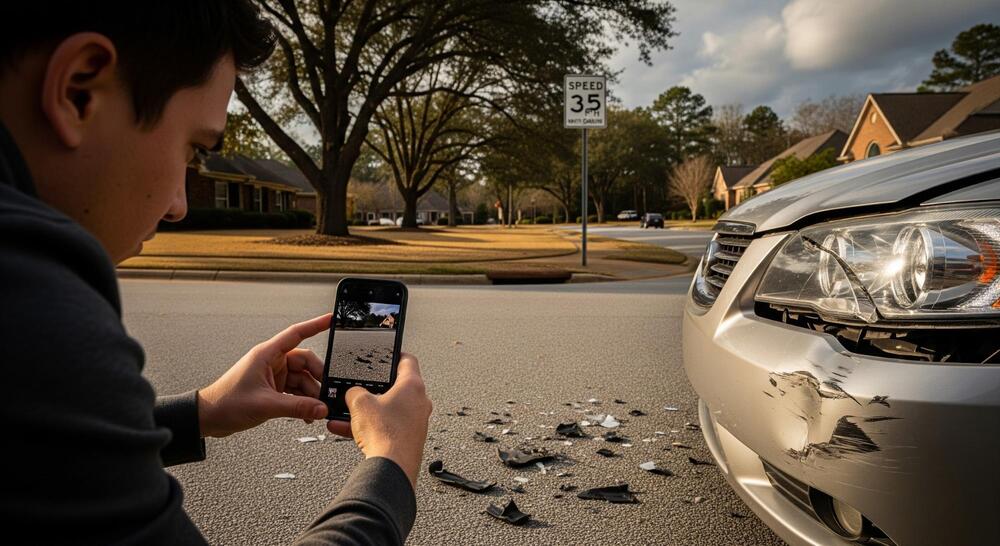
Right after a crash, it can be hard to think clearly about anything beyond making sure everyone is safe and getting medical help. Once that immediate danger has passed, the photos you take with your phone can become some of the most important pieces of evidence for an insurance claim or injury case. Clear images of the scene, the vehicles, the road, and your injuries help explain what really happened in a way that a written description or memory often cannot, especially when stories change or fault is disputed later.
Focusing on a simple checklist makes it easier to work through those stressful moments. Wide shots of the overall scene, detailed photos of every side of each vehicle, close-ups of skid marks and debris, and careful images of visible injuries and key documents all work together to tell a complete story. When gathered safely and handled correctly, these pictures can help protect you under North Carolina’s contributory negligence rule by filling in details that crash reports and adjuster notes sometimes leave out.
Photo Checklist for After a Car Accident
When it is safe, North Carolina drivers should focus on photographing five things with a phone:
- The overall scene
- Each vehicle
- Road and weather conditions
- People and key documents
- Any visible injuries
These photos can later help insurance companies, lawyers, and courts understand what happened and how serious the crash was, but safety and medical care always come first when deciding what photos to take after a car accident.
Quick Photo Checklist
- Scene: Wide shots of the overall scene, vehicle positions, and any traffic controls
- Vehicles: All sides of each vehicle, close-ups of damage, license plates, and VINs
- Roadway: Skid marks, debris, weather and lighting, construction or hazards
- People and documents: Other drivers’ information, report number or officer’s card, witness contact information
- Injuries: Visible bruises, cuts, swelling, and damaged clothing when appropriate
To use this checklist in the moment, start with the overall scene, then move in closer for vehicles, road conditions, people and documents, and finally injury photos.
What Photos Should I Take Before Anything Changes?
Because crash scenes can change quickly, it helps to get a few key shots before vehicles move or debris is cleared, as long as you are not in danger and it is legal to stay where you are.
Helpful first photos include:
- A wide shot of the entire scene from a safe distance
- Photos showing where each vehicle ended up relative to lanes and landmarks
- Photos of traffic lights, stop signs, or yield signs that control the intersection
- Photos of license plates on each vehicle
- Quick shots of any visible skid marks or debris patterns
- Photos of obvious injuries if you can safely do this without delaying medical care
After you capture these priority shots, you can spend more time on detailed scene, vehicle, road, and injury photos.
Scene Photos That Show How the Crash Happened
Scene photos give context for how the crash occurred. They help show where each vehicle came from, what traffic controls were present, and what each driver could see. This context is often important when adjusters and lawyers decide who was at fault.
Key Scene Photos to Capture
- Each direction of travel approaching the crash area from driver eye level
- Position of vehicles relative to lanes, intersections, medians, and landmarks
- Traffic lights, stop signs, yield signs, and lane arrows
- Crosswalks, stop lines, and turn lanes
- Any visual obstructions such as parked vehicles, trees, curves, or construction barriers
- Nearby businesses, homes, or cameras that may have recorded the crash
These context shots are especially helpful when fault is disputed or when the crash report is incomplete or inaccurate. Intersections are some of the most common crash locations, so it helps to know exactly what to photograph there.
What Should I Photograph at an Intersection in Raleigh, Charlotte, or Wilmington?
At intersections in cities like Raleigh, Charlotte, or Wilmington, details of signals, signs, and lanes are critical for understanding who had the right of way. Use the general scene checklist above, and at intersections be sure to capture:
- Each approach direction to the intersection from driver eye level
- Signal heads and turn arrows from the approach that mattered
- Stop lines, crosswalks, and turn-only lanes
- Stop signs, yield signs, or multiway stop signs
- Nearby trees, signs, or buildings that might block the view of signals or other vehicles
- Storefronts, gas stations, or traffic cameras that might have captured the crash
In addition to still photos, a short video can help tie all of these pieces together.
Should I Take Video Too?
After you take still photos, a slow walk-through video from a safe distance can show the overall scene and how everything fits together. Video can capture the relationship between vehicles, lane markings, traffic controls, and landmarks in a way that is easy to replay later.
Still photos are usually clearer for zooming in and printing, so you should not rely on video alone. A combination of still photos and a short video gives the best record when you later describe what happened. Once the scene is documented, the next step is getting thorough photos of each vehicle involved.
Vehicle Photos That Make Damage Hard to Dispute
Vehicle photos help show how hard the impact was, where the vehicles struck each other, and whether each driver’s story matches the physical damage. They also help if there is a later dispute about repairs, total-loss valuations, or the relationship between damage and injuries. Here are some vehicle photo essentials to remember:
- Four-corner walkaround shots of each vehicle
- Straight-on shots of the front, rear, and both sides of each vehicle
- Close-ups of each impact point and scraped, bent, or cracked areas
- Photos of license plates and VINs on the dashboard or door sticker
- Interior shots of airbags, broken glass, and damaged dashboards
If the car is being towed or is already at a lot, you should still try to get as many of these shots as possible, even if you need to return later with permission. Here are some common questions about getting complete vehicle photos in real-world North Carolina crashes.
What Angles Should I Get for Each Vehicle?
Think of it like doing a slow lap around each car so you capture every side of the damage story. Helpful angles include:
- One photo from each corner of the vehicle (front left, front right, rear left, rear right)
- Straight-on photos from directly in front and directly behind
- Side shots centered on each door line
- Extra close-ups of major dents, crumpling, broken lights, and other damaged parts
If your car was moved before you could do this, you still have options.
What If the Cars Were Moved Before I Could Take Pictures?
If vehicles had to be moved for safety or to clear traffic, you can still photograph their new positions and the road area where the collision occurred. Use nearby signs, intersections, mile markers, or landmarks in your photos to show location and orientation.
You can also return later, if it is safe, to photograph skid marks, debris stains, and road features. The DMV-349 crash report and the officer’s report number can help your lawyer tie your photos back to the exact crash location on a North Carolina roadway. You should also remember to capture the inside of the car, not just the outside.
Should I Photograph the Inside of the Car After a Crash?
Interior photos can show how hard you and your passengers were thrown around and can help explain certain injuries. Deployed airbags, cracked dashboards, and broken glass all help tell that story. Useful interior photos include:
- Shots of deployed airbags, shattered glass on seats or floors, and damaged dashboards
- Photos of seat belt positions and child car seats
- Images of any interior intrusion where a door or panel was pushed into the passenger space
In serious North Carolina cases, these details can help experts reconstruct what happened. Next, you should capture the road and environmental conditions that insurance companies often rely on when analyzing fault.
Road and Environment Photos Insurance Companies Rely On
Road and environment photos show whether drivers were adjusting to conditions like rain, curves, traffic, or construction. This is important when insurers and lawyers decide whether someone failed to drive carefully for the conditions on roads such as I-40, I-85, I-95, US 1, US 64, or local streets near neighborhoods and business districts. Helpful road and environment shots to take include:
- Skid marks, yaw marks, and tire tracks leading to and from the impact area
- The debris field and any fluid spills on the pavement
- Potholes, broken pavement, or gravel patches where traction might have been reduced
- Construction cones, signs, lane shifts, or closed lanes
- Weather conditions such as wet pavement, snow, fog, or bright sun glare
- Street lighting, visibility, and shadows at the time of the crash
These conditions can help show that a driver failed to slow down, failed to leave enough space, or failed to pay attention, which is especially important under North Carolina’s contributory negligence rule. In addition to what happened to your car, your photos should also show what happened to you.
What Road Conditions Should I Capture to Support Fault?
Adjusters and lawyers often look closely at road and weather conditions when deciding who was careful and who was not. From the broader road and environment list above, be sure to capture:
- Condition of the road surface, whether it was dry, wet, icy, or full of potholes
- Visibility from each driver’s perspective, including curves and hills
- Location of warning signs such as speed limits, curve warnings, and work zone notices
- Any temporary obstructions such as construction equipment or parked vehicles that narrowed lanes or blocked sight lines
Finally, do not forget that your injuries and key documents can also be captured in photos that help your North Carolina claim.
Injury and Document Photos That Support a North Carolina Claim
Early injury photos and document photos can fill gaps in written records and support your version of events. Bruising, swelling, and abrasions change quickly, and paper documents can be damaged or misplaced. Helpful photos include:
- Close-ups and medium shots of bruises, cuts, swelling, and bandages
- Photos of casts, braces, slings, crutches, or other assistive devices prescribed after the crash
- Photos of torn or bloodied clothing from the crash
- Photos of exchanged documents such as insurance cards, driver’s licenses, and registrations when other drivers voluntarily share them
- Photos of the officer’s business card, badge number, or report number
Photos should be factual and not staged, and you should never delay emergency medical care just to take pictures. Two common questions are about timing for injury photos and whether it is okay to photograph other drivers’ cards.
What Injury Photos Help Most in the First 72 Hours?
Bruises, swelling, and surface injuries often look different from day to day. Taking photos within the first 72 hours can show their full extent before they fade or change color. This can help doctors and insurers understand how forceful the crash was.
It can also help to take a few photos over several days to show progression, with both close and medium distance shots. These images can help your doctor and lawyer tell your story more clearly, especially when written notes do not capture the full visual impact of your injuries.
Is It Okay to Photograph Insurance Cards and Driver’s Licenses?
If another driver in North Carolina is willing to exchange information, taking clear photos of their insurance card, driver’s license, and registration can prevent mistakes when you report the claim. It is usually easier and more accurate than copying long numbers by hand at the roadside.
These photos should be treated like any other sensitive document. Do not post them on social media, and share them only with your insurer, your lawyer, or law enforcement. Finally, here are some North Carolina-specific evidence tips and common photo mistakes to avoid.
North Carolina Evidence Tips and Common Photo Mistakes to Avoid
In North Carolina, your photos are part of a larger evidence picture that includes the DMV-349 crash report, medical records, and witness statements. Together, they help insurers and courts understand how the crash happened and how it affected you.
The way you take and handle photos can either strengthen or weaken your claim. Good photos and careful handling can support your version of events. Gaps and mistakes can raise questions about what really happened on the road.
NC Evidence Tips and Pitfalls
- Always prioritize safety and medical care before taking photos
- Keep original, unedited files and avoid heavy filters or edits
- Back up photos and label them so you remember what they show and when they were taken
- Avoid sharing accident photos publicly on social media
- Remember that North Carolina’s contributory negligence rule means missing context such as lane markings or traffic signs can create doubt about fault
How Do Photos Fit with the DMV-349 Crash Report in North Carolina?
The DMV-349 is the standard crash report form used by North Carolina law enforcement. It includes the officer’s narrative, diagram, and coded entries that describe factors such as driver actions, road conditions, and contributing circumstances.
Your photos can support or clarify what is written in that report. If the diagram seems inaccurate or a code suggests something that does not match your memory, your photos may help your lawyer or insurer understand the truth and, in some situations, request clarification. They can also help answer questions about contributory negligence by adding detail that the officer did not capture.
What Photo Mistakes Make Claims Harder in North Carolina?
Certain common mistakes can limit how helpful your photos are for a North Carolina claim. Avoid these pitfalls when possible:
- Taking only close-ups with no wide shots for context
- Failing to capture traffic signals, signs, or lane markings
- Forgetting to photograph license plates or VINs
- Taking mostly blurry, dark, or glare-ruined photos
- Waiting until after vehicles are towed and the scene is cleaned up
- Editing or cropping photos in a way that removes important details
If you were too injured or shaken to take any photos, you still have options.
What Should I Do If I Was Too Hurt to Take Photos at the Scene?
Many North Carolina claims are still successful even when the injured person could not take photos at the scene. Evidence such as the DMV-349 crash report, officer photographs, tow-yard damage photos, dashcam footage, and medical records all still matter.
You can help your case by taking photos of your vehicle and injuries as soon as you are able, asking family or friends to help, and considering a consultation with a North Carolina car accident lawyer. A lawyer can help gather crash reports, request nearby surveillance footage, and track down other evidence you could not collect yourself.
Get Help Using Your Photos to Protect a North Carolina Car Accident Claim
If you are unsure whether the photos you took after a North Carolina car accident are enough, you do not have to figure that out alone. Pictures of the scene, vehicles, road conditions, injuries, and key documents can help protect you under contributory negligence rules, but missing angles, unclear images, or gaps in other evidence can give insurers room to question your story. Early legal guidance can help you understand which photos matter most, how they fit with the DMV-349 crash report and witness statements, and what additional evidence you may still be able to gather after the scene is cleared.
If you have questions about what photos you should take after a car accident or how to use the images you already have from a crash in Raleigh, Charlotte, Wilmington, or anywhere in North Carolina, you do not have to make those decisions on your own. Call 919-342-1368 or contact us online for a free consultation. We’re ready to review your photos, crash report, and medical records, explain how North Carolina’s fault rules affect your claim, and fight like heavyweights to protect your right to pursue fair compensation.
