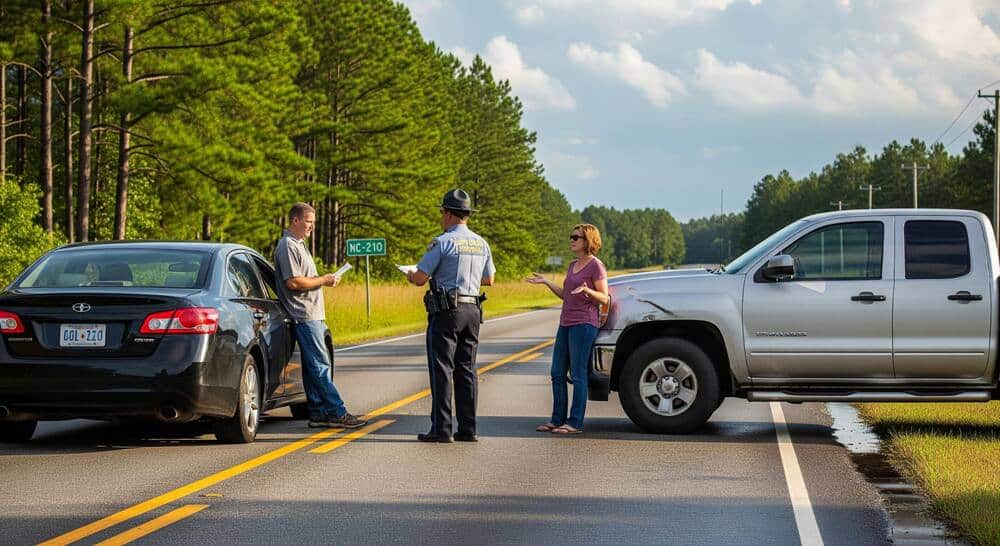
A North Carolina car crash can leave you shaken, especially if everyone drives away without calling the police. Many people later worry they ruined their claim because there is no official crash report from Raleigh PD, Charlotte-Mecklenburg Police, or a local sheriff’s office. The reality is that you can often still pursue an insurance claim or lawsuit, but you must use other forms of proof to show how the collision happened, who was at fault, and how your injuries and financial losses tie back to the wreck.
North Carolina law also has specific rules about when a crash must be reported, how reportable accidents are documented, and how long you have to bring a claim in court. Understanding those rules helps you avoid unnecessary mistakes. It also helps you gather the right evidence from day one and reduce the chances that an insurer uses the missing report as an excuse to delay or deny your claim. With the right information and support, you can still move forward after a collision in Raleigh, Charlotte, Wilmington, or anywhere else in the state, even when there is no police report in your hand.
Yes, You Can Often File a North Carolina Claim Without a Police Report
You can usually start a car accident claim in North Carolina even when there is no police report. A crash report often helps, but it is not a legal requirement just to notify an insurance company or to begin exploring your options with a lawyer.
What does not change is what you must prove. To recover compensation, you still need evidence that shows:
- How the crash happened and who was responsible
- What injuries you suffered
- How those injuries and the crash affected your finances and daily life
- A clear and consistent timeline from the collision forward
At the same time, you must pay attention to North Carolina’s rules about reportable crashes. If your collision meets the legal definition of a reportable accident, you are supposed to notify law enforcement, even if you plan to build your proof from other sources.
That leads to two common questions: Can you still file with insurance, and can you still sue the at-fault driver?
Can I Still File an Insurance Claim in North Carolina If Police Did Not Come?
Yes. You can usually file an insurance claim in North Carolina even when officers never responded and no crash report was written.
You should:
- Notify your own insurer promptly
- Give basic facts about where and when the crash happened
- Stick to what you know and avoid guessing about speed or fault
- Let the investigation process unfold before making firm statements about how the crash occurred
The other driver’s insurance company can accept and investigate a claim even when no report exists. However, without an officer’s narrative to start from, the insurer may take longer, ask more detailed questions, and focus heavily on your documentation. That makes it important to begin preserving evidence right away.
Can I Still Sue the At-Fault Driver Without a Police Report in North Carolina?
Yes. You can sue the at-fault driver in North Carolina even if no police report exists. Courts do not require a crash report to file a lawsuit. Instead, the court will look at all of the available evidence to decide what happened and how it harmed you.
Filing an insurance claim is simply notifying and working with an insurer. Filing a lawsuit is a formal legal step with court deadlines and procedural rules. North Carolina also has time limits for many car accident lawsuits. In many injury cases, the time limit is often three years from the date of the crash under North Carolina’s general statute of limitations for personal injury. That means you should not wait too long to talk with a lawyer about your options.
Even though a police report is not always required to start a claim, North Carolina law does require calling law enforcement in certain crashes. Those rules matter both for legal compliance and for how insurers view your case.
When North Carolina Law Requires Reporting a Crash to Law Enforcement
North Carolina law requires drivers to notify law enforcement after certain “reportable accidents.” If your crash meets those criteria, there is a legal duty to report it, regardless of whether you plan to file an insurance claim or lawsuit.
In general, reportable crashes include collisions that involve injuries, deaths, or significant property damage. The detailed triggers come from state law and the official crash reporting rules.
What Counts as a Reportable Accident Under G.S. 20-166.1?
Under North Carolina law, officers use a DMV-349 crash report form to document reportable accidents once they are notified. A crash is usually considered reportable when any of the following are present:
- At least one person complains of or shows signs of injury
- Any crash in which a person dies
- Crashes where total visible vehicle and property damage appears to be around one thousand dollars or more
- Crashes where a vehicle cannot be safely driven away and is left on the road or blocking traffic
It can be difficult to estimate damage at the scene, especially after a high stress event or a collision on I-40, I-85, or I-95. If you are not sure about damage or injuries, calling law enforcement is often the safer choice. Many drivers also wonder what happens after so-called “minor” crashes.
Do I Have to Call the Police After a Minor Crash in North Carolina?
A crash that feels minor does not automatically fall outside the reporting rules. A low speed rear end bump on a city street in Raleigh could still cause more than one thousand dollars in bumper and sensor damage. You should ask yourself the same basic questions:
- Is anyone complaining of pain or showing signs of injury?
- Does anything suggest that a person could be seriously hurt?
- Does the damage look like it could reach or exceed the thousand dollar threshold?
- Can all vehicles be safely driven away without blocking traffic or creating a hazard?
If the crash appears reportable, you should call law enforcement and attempt to get an officer to respond. If officers do not respond or tell you to exchange information and leave, you still need to document the scene thoroughly.
If you cannot get an officer to respond, try to:
- Take clear photos and video of the scene, vehicle positions, and road conditions
- Exchange driver’s license and insurance information with the other driver
- Get names and contact details for any witnesses who saw the crash
- Seek medical evaluation if you notice pain, dizziness, confusion, or other symptoms
- Notify your insurer and explain that police did not respond
Even when you believe the crash was minor, you may later realize that it should have been reported. Many people are unsure what to do at that point.
What Happens if You Do Not Report a Reportable Crash in North Carolina?
If you did not report a crash that probably should have been reported, you are not alone. People often feel shocked or confused at the scene, and only later realize they may have missed a step. The important thing is not to panic, but to focus on practical steps you can take now.
You may face questions about why law enforcement was not called. There can be potential legal consequences for failing to report certain accidents. A lawyer can help you understand whether your situation likely involved a reportable crash and how that might affect your case.
In the meantime, helpful steps include:
- Writing down exactly what happened while your memory is fresh
- Saving any photos, video, and text or email exchanges about the crash
- Getting evaluated by a medical provider if symptoms develop or continue
- Notifying your insurer and being honest that police were not called
- Asking a lawyer about how to request any existing report if an officer later filed one
Whether or not you called law enforcement, the next concern for most people is what changes for an insurance claim when no police report exists.
What Happens to Your Claim If There Is No Police Report?
The lack of a police report does not automatically end a North Carolina car accident claim. However, it can increase scrutiny, lengthen the investigation, and make fault disputes more likely, especially under North Carolina’s contributory negligence rule, where an allegation of partial fault can be very serious.
Without a report, several things often change:
- The investigation may take longer
- Insurers may ask for more documents and detailed explanations
- Fault may be disputed more frequently, particularly when there are no independent witnesses
- Injury timelines may be scrutinized more closely, especially when there were delays in seeking medical care
Insurers often ask for police reports because these documents give them a neutral starting point for their review.
Why Do Insurance Companies Ask for a Police Report?
Insurance companies like police reports because they provide an early, structured record of the crash. A typical report includes:
- Names, contact details, and insurance information for the drivers
- Information about vehicle makes, models, and damage locations
- The crash location, time, and road and weather conditions
- An officer’s narrative and a diagram that show how the collision appears to have happened
- Witness contact information and statements, if any were taken
This helps insurers verify basic facts, locate potential witnesses, and understand the apparent sequence of events. A report can be helpful, but it is not the only way to show what happened. Insurers can still evaluate claims when other evidence fills the gaps.
Will the Other Driver’s Insurance Deny My Claim Without a Report?
An insurance company can deny a claim, but it does not have to deny one just because there is no police report. Insurers may pay claims without reports when the other evidence clearly supports what you are saying about fault, injuries, and losses.
Denial becomes more likely when several risk factors appear together. These can include:
- Conflicting stories about what happened
- No independent witnesses
- Delays in seeking medical care
- Limited proof of damage or financial loss
To reduce the risk of denial, you want to focus on building strong documentation and consistent timelines. That is where substitute evidence becomes extremely important.
Evidence That Can Replace a Police Report
You can think of your evidence as a packet of proof that covers responsibility for the crash, the injuries you suffered, and the financial impact on your life. The more complete that packet is, the less your claim depends on having a police report.
Below is a structure that many people find helpful.
| Evidence Type | What It Shows | How to Get It |
| Scene photos and video | Vehicle positions, lanes, signals, and road conditions | Take with your phone at or soon after the crash |
| Vehicle positioning notes | Where vehicles stopped relative to lanes and landmarks | Sketch or write notes right after the crash |
| Dashcam footage | Vehicle movements, signals, sudden stops, and the impact | Download and save from your device as soon as possible |
| Witness statements | Independent descriptions of what happened | Ask witnesses for contact information and written statements |
| 911 call and CAD log | Timing, location, and basic description of the crash | Request records from the local agency or dispatch center |
| Business or doorbell video | Visual record of the approach and impact | Contact nearby property owners promptly |
| Tow and storage receipts | That your vehicle was disabled and needed removal | Save invoices from the tow company and storage lot |
| Repair estimates and bills | Points of impact, severity of damage, and cost of repairs | Keep body shop estimates and final invoices |
| Medical visit notes | Injuries, symptoms, and initial diagnoses | Request records from the ER, urgent care, and doctors |
| Imaging reports | Objective proof of fractures or other internal injuries | Obtain copies of X-ray, CT, or MRI reports |
| Therapy or rehab notes | Ongoing limitations, pain levels, and progress | Request notes from physical or occupational therapists |
| Prescription information | Pain management and treatment plans | Save pharmacy printouts and medication lists |
In the first 24 hours after a crash, time-sensitive steps include:
- Taking scene photos and video from different angles when it is safe
- Writing down vehicle positions and what you remember as soon as possible
- Collecting driver and witness contact information, including phone and email
- Preserving dashcam footage and asking nearby businesses or homeowners about cameras
- Seeking medical evaluation if you feel any pain, stiffness, dizziness, or confusion
- Notifying your insurer and keeping notes on all conversations
From there, you can focus on specific types of proof.
What Evidence Helps Prove Fault Without a Police Report?
Fault is usually supported by physical evidence and independent corroboration. Without a police report, those sources become even more important. Helpful proof includes:
- Photos of vehicle positions relative to lanes, intersections, and landmarks
- Photos of lane markings, traffic lights, stop signs, and turn arrows
- Close-ups of vehicle damage patterns and impact points
- Photos of skid marks, debris fields, and fluid spills on the roadway
- Dashcam footage from your vehicle or from others who share it with you
- Names and contact details for any witnesses, even if they only saw part of the crash
- Notes on nearby businesses, parking garages, or homes that may have relevant camera footage
This type of evidence helps reconstruct what each driver was doing, what traffic controls were in place, and how the collision unfolded.
What Medical Records Matter Most if There Is No Police Report?
Early and consistent medical documentation ties your injuries to the crash and helps prove both that you were hurt and that the wreck caused those injuries. Records that often matter most include:
- Emergency room or urgent care visit notes from the day of the crash
- Follow up records from your primary care doctor and any specialists
- Imaging results such as X-rays, CT scans, or MRIs
- Physical therapy or rehabilitation treatment notes
- Prescription lists and discharge instructions
- Work restriction or light duty notes from health care providers
- A personal symptom journal noting pain levels and activity limits over time
When there is no police report, insurers may question whether the crash actually caused your symptoms. A clear medical timeline helps address those concerns.
What Third-Party and Digital Evidence Can Help if There Is No Police Report?
Third-party and digital records can reduce credibility disputes because they come from outside sources. These records show that important parts of your story were recorded in real time by others. Useful sources include:
- 911 call logs and computer aided dispatch (CAD) records
- Tow and storage documentation from the tow company and lot
- Repair shop estimates and final invoices
- Rental car, rideshare, or transportation receipts related to the crash
- Video from nearby businesses, parking garages, or homes with cameras
- Doorbell camera footage from homes along the route
- Dashcam footage from your vehicle or from other drivers who share it
Many camera systems overwrite footage quickly, sometimes within days. That is why acting quickly to request and preserve these records is important. If an officer did respond or a report exists, you can request it later and add it to your evidence packet.
How to Get the Official North Carolina Crash Report Later
In many reportable accidents, the responding officer completes a DMV-349 crash report. You may not have received a copy at the scene. Even so, you can often request a redacted copy later for your records and for your claim.
Before you request a report, it helps to gather:
- The date and approximate time of the crash
- The exact or approximate location and road names
- The names of the drivers involved
- The name of the law enforcement agency, if you know it
- The county where the crash happened
Once you have this basic information, you can request the report through the North Carolina Division of Motor Vehicles (NCDMV).
What Is the DMV-349 Crash Report Form?
The DMV-349 is the standard officer crash report form used in North Carolina. It typically includes:
- Information about the drivers and vehicles
- The location of the crash and the road and weather conditions
- A diagram of the collision
- An officer’s written narrative
- Any noted contributing circumstances and violations
The DMV-349 does not decide fault by itself. It is a record that insurers, lawyers, and courts may review as one piece of evidence among many. Other proof, such as photos, medical records, and witness statements, can support or challenge the officer’s impressions.
How Do I Order a Crash Report from NCDMV, and What Is TR-67A?
Involved individuals usually request North Carolina crash reports by mail or in person, rather than through the online system that some organizations use. When you request a report, you typically receive a redacted copy that protects certain personal information under privacy laws.
TR-67A is the crash report request form that NCDMV uses. It asks for information about who you are, how you are connected to the crash, and which report you are asking for. You complete the form, submit it with the required fee according to NCDMV instructions, and then wait for processing.
Practical request tips include:
- Use the exact spelling of names as they appear in other records
- Provide as much detail as you can about the date, location, and law enforcement agency
- Follow NCDMV mailing or in-person instructions carefully
- Keep a copy of everything you send and any postal or delivery tracking information
If you are unsure how to organize your evidence or request the report, a lawyer can handle these tasks as part of your case.
Get Help Building a North Carolina Claim Without a Police Report
If you are worried that the lack of a police report ruined your North Carolina car accident claim, you do not have to try to solve that problem alone. Insurers sometimes use a missing report as a reason to delay, question fault, or argue that your injuries are not connected to the crash, especially under contributory negligence rules. Early legal guidance can help you understand whether your crash should have been reported, how serious any reporting issues might be, and what steps you can take now.
A lawyer can help you:
- Review North Carolina reporting rules and statute of limitations deadlines
- Identify and gather substitute evidence such as photos, medical records, repair and tow documents, 911 logs, and witness information
- Request the DMV-349 crash report if one exists
- Organize a clear packet of proof that explains what happened, how you were hurt, and how the collision affected your life
If you were involved in a car accident anywhere in North Carolina and are unsure how to move forward without a police report, you do not have to guess what evidence is enough or how to respond to the insurance company. Call Lanier Law Group at 919-342-1368 or contact us online for a free consultation. The lawyers at Lanier Law Group are ready to review your available records, explain how North Carolina reporting and statute of limitations rules apply, and fight light heavyweights to protect your right to pursue fair compensation even when an official crash report is missing or incomplete.
